
Two names come up every time a friend asks me about pressing shirts at home: the Cricut EasyPress SE and the HTVRONT heat press. I own the first one. I have never used the second, and I am not going to pretend otherwise.
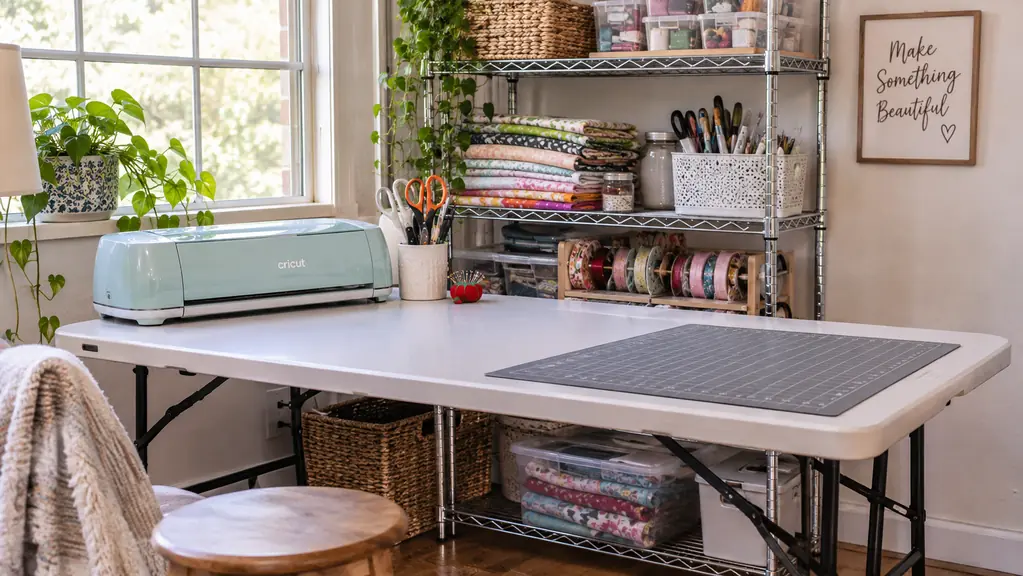
So this is not a side-by-side test with a stopwatch on the counter. It is a plain comparison from the side of the table where I actually sit: a six foot folding table in my spare bedroom in Tulsa, a small vinyl cutter at one end, a pressing mat at the other, and five months of pressing behind me since June. Everything I tell you about the HTVRONT comes from its published details, not from my hands.
I want to be careful about that, because a comparison written by somebody who owns only one of the two can go crooked without meaning to. So here is how I am handling it. Where I have used the thing, I tell you what happened and roughly when. Where I have not, I say so and I stick to what the listing says and nothing beyond it. I am not going to invent a test I did not run, and I am not going to invent a flaw in somebody else's machine to make mine look wiser. What I can offer is five months of ordinary use at one folding table, and an honest account of where that experience stops.
The short answer is this. If your pressing is a few shirts at a time, for church volunteers or for family, the Cricut EasyPress SE does the work and asks very little of you. You lift it, you set it down on the shirt, you wait, you lift it again. If you want a whole shirt front pressed flat in one go with both hands free, a clamp-style press such as the HTVRONT is the more sensible tool, and I would tell you that at my own table without hesitating. I can speak in detail only to the Cricut, because it is the one on my wire shelf, and because five months of shirts have gone under it. The rest of this piece is the working out: what I press, how the thing handles, where it runs out of room, and what you give up by choosing it.
| Cricut EasyPress SE | HTVRONT Heat Press | |
|---|---|---|
| Pressing surface | 12 in x 10 in, which covers a shirt front | Sold in several sizes and styles. I have not measured one, so I will not quote numbers |
| Settings | Time and temperature for each material come from the Cricut Heat Guide, published by the brand | I have never used one, so I cannot say what setting help comes with it |
| Handling | A handheld plate. You lift it, set it down, lift it again | Several HTVRONT models are clamp-style presses that hold the garment flat and leave both hands free |
| Bigger pieces | Fine on a shirt front. Anything larger gets pressed in sections | A clamp press takes a full shirt front or a wide tote laid flat in one go |
| Storage | 13.7 by 4.7 by 11.5 inches, light enough for the top shelf of a wire rack | Going by the listing, a clamp press is a larger machine than a handheld plate. I have never had one in my room |
| Warranty | One year limited warranty from Cricut | HTVRONT publishes its own warranty terms. I have never tested them |
| Best for | Small runs of shirts, a tote, a couple of pillow covers, at home scale | Larger flat work and longer runs where you want both hands free |
Where the Cricut EasyPress SE Wins
What sold me was not the press itself. It was the guide.
Every material wants its own time and temperature, and I am not the kind of person who holds numbers in her head. I spent thirty years keeping other people's schedules for a living; my own I kept on the back of an envelope. The Cricut Heat Guide gives you the setting for the material in front of you, along with the order of the steps, and I have opened it every single time I have pressed anything since June. I have never once had to guess. The press is rated to 400 degrees Fahrenheit, which is more than anything I have put under it has needed.
That sounds like a small thing until you have stood over a shirt with a household iron, guessing. I did that twice before the press arrived. It was June, the shirts for Bible school were already ordered, and I thought I could save myself a purchase. I set the iron by feel because I had no guide to set it by, pressed two test shirts, and when I pulled the carrier sheet back the lettering lifted at the corners. Neither shirt was ever washed or worn. Both went in the trash, and I ordered the Cricut that week. Iron-on was brand new to me then. I had cut no iron-on at all before that June, only vinyl.
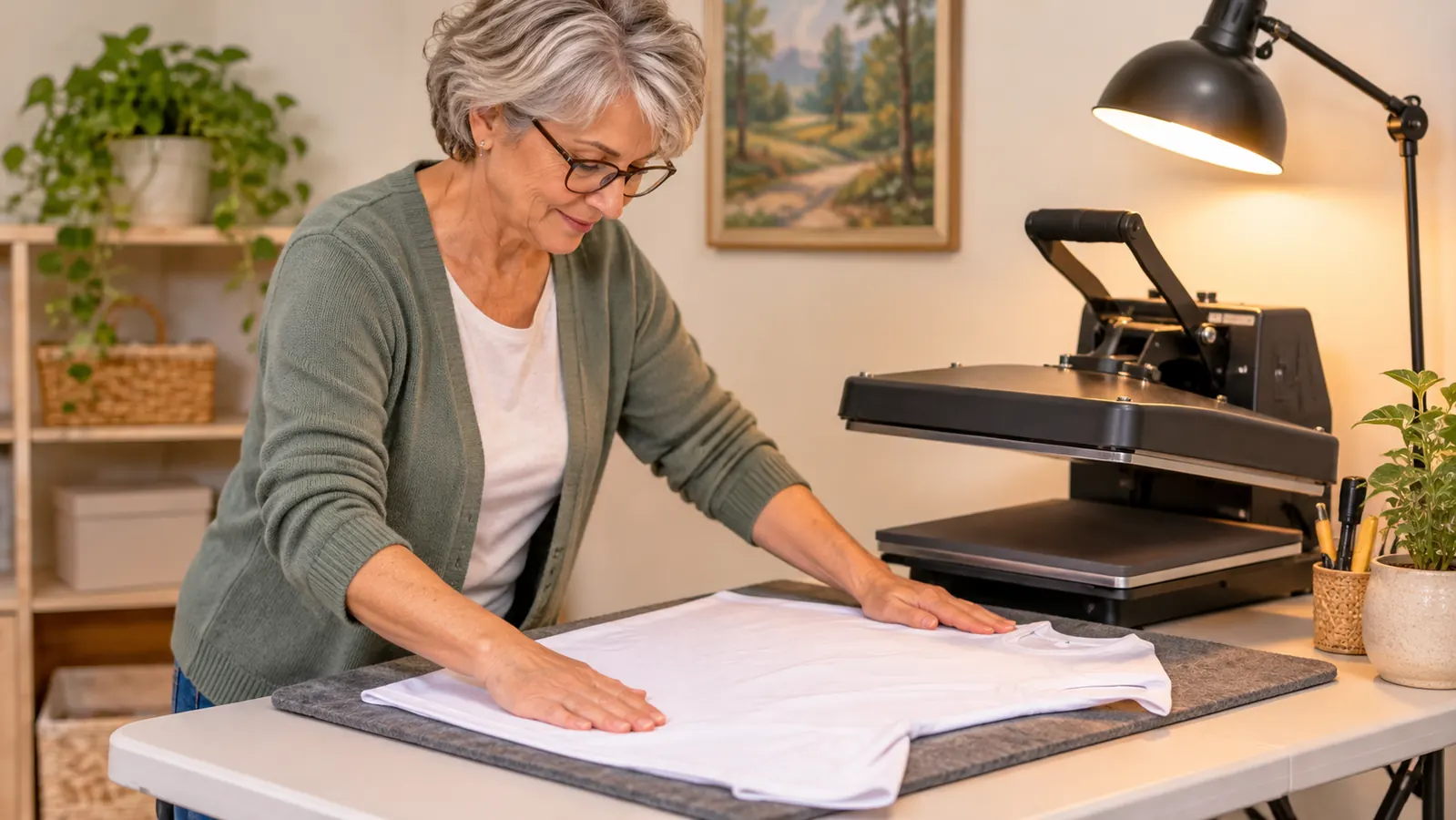
The job that justified the press was fourteen shirts for our church's summer Bible school volunteers, black iron-on, done in one long afternoon on the folding table. I want to tell you how that afternoon actually went, because it is the clearest picture I can give you of the machine. I stacked the shirts on the spare bed, sorted by size. The pressing mat went at the right end, where it still is. I set the press on its base, let it come up to heat, and worked one shirt at a time: smooth the front flat with the flat of my hand, size the 12 by 10 plate against the shirt front so I knew where the edges would fall, set it down, wait, lift, set it back on its base, peel the carrier sheet back slowly and look at the corners. Then the next one. Fourteen times, one after another, and every one of them came out clean. Fourteen is not a big number to a shop. It is a big number to somebody who had never pressed a shirt before that month.
Since then it has done one canvas tote, two pillow covers for Ruth next door, and a few shirts that went to the craft fair in October. That is the whole list. Five months, and that is the whole list. Cricut lists the press for shirts, sweatshirts, tote bags, pillow covers, hats, socks and a handful of other flat-ish things. I can only vouch for the ones I have actually put under it, and the ones I have put under it are the ones I just named.
I will not tell you it is fast. It has to come up to heat, and while it does you stand there with nothing to do but smooth out the next shirt and check that the mat is straight. Then you press the front, lift, shift the shirt, press the next section. On anything bigger than a shirt front you are working in sections. That is the trade you make for a plate you can pick up with one hand. The plate is ceramic, which is why it holds its heat evenly across the surface, and it is also why the whole thing has some weight to it. Not heaviness that tires your arm over fourteen shirts. Enough that you know you are holding something.
The other thing I did not expect to care about is where it lives. It measures 13.7 by 4.7 by 11.5 inches, and when I am not using it, it sits on the top shelf of my wire rack, above the bin where the vinyl rolls stand upright. Going by the listing, a clamp press is a larger machine than this, and I would have to find it a home. In a spare bedroom that already holds a cutter, a laptop and a bin of rolls, that matters more than I would have guessed when I ordered it. Cricut backs it with a one year limited warranty. I have not had to use it, so I cannot tell you how that goes, only that it is there in writing.
Where the HTVRONT Heat Press Wins
Here is where I would send you the other way, and I want to be straight about it.
The EasyPress SE is a handheld plate. That is its design and that is its limit, and I knew both when I bought it. On anything bigger than a shirt front you press in sections, and you are standing over it the whole time with your hands on the handle. A clamp-style press, which is what several HTVRONT models are, holds the garment flat between two surfaces and leaves both your hands free while it works. If you are pressing a back panel, a tote bag spread out wide, or a stack of shirts one after another, that is not a small convenience. It is the difference between an afternoon of work and an afternoon of standing in one spot with your arm going numb.
The second place it wins is choice, and I mean the shape of the machine more than anything about money. HTVRONT sells more than one style, so you can pick the size and the format that fit the work you actually do instead of the work I do. That is worth something to a person who has already decided heat pressing is going to be part of her week. When I was deciding in June, I read the listings slowly and with a pencil. The clamp presses were the ones that made me stop and think. They take a full shirt back or a wide tote laid flat in one go, and they hold it there without you. My work has never needed that. If yours does, the listing is telling you something true about the tool.
I have not used the HTVRONT. I am reading the same listings you are reading. But the shape of the thing tells you what it is for, and it is for flatter, larger work than mine.
The third place it wins is the one nobody wants to talk about, which is that the Cricut name is part of what you are paying for, and I knew that when I bought it. There are other ways into heat pressing, and HTVRONT is one of the names on the list. I am careful with money. I worked in a school office, not in business, and every tool in that room came out of a household budget. I still chose the Cricut, and I would choose it again, but I want to be honest that part of what I bought was a guide I trusted and a name I had heard of. If neither of those is worth anything to you, you have more room to shop than I gave myself.
I have never used an HTVRONT, so I cannot tell you what setting help comes with one. The Cricut Heat Guide is the part I lean on every time. You get the flat work and the free hands. Check what comes with it for settings before you buy.
The press I actually own, if your work looks like mine
A few shirts at a time, a tote, a couple of pillow covers, all on one folding table. That is what the Cricut EasyPress SE was built for at my house, and it is the one I can speak about from five months of use.
Amazon Check Today's Price on Amazon →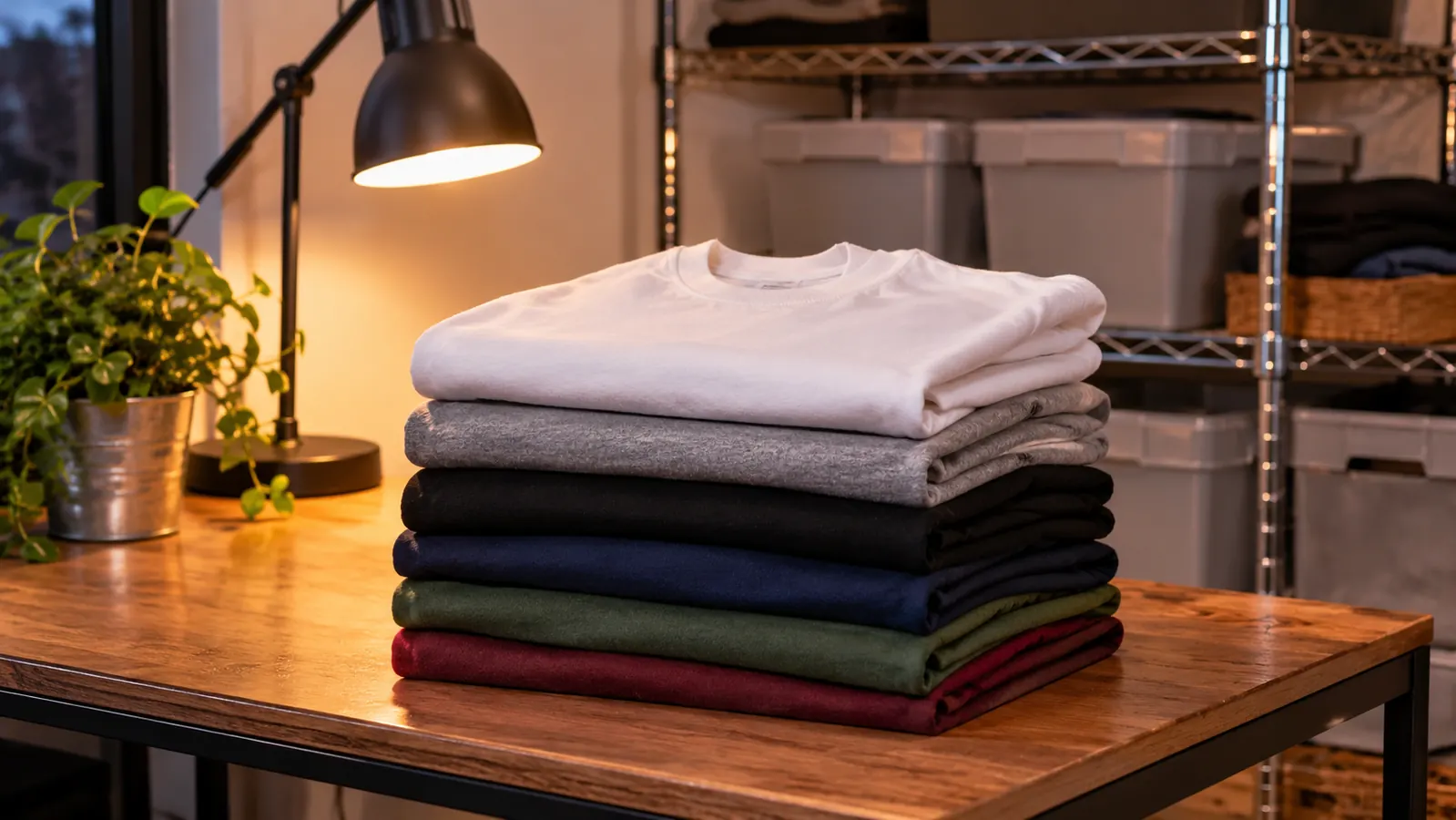
Who Should Buy Which
Buy the Cricut EasyPress SE if you press a handful of shirts at a time and you want to be told what setting to use. That is the reader I picture: somebody at a folding table with a cutter at one end, a church group asking for fourteen shirts, a neighbor who wants two pillow covers. You want a tool that fits on a shelf and that you can lift with one hand. You do not mind pressing in sections, because your sections are small.
I would add one more kind of reader to that list, because she is the one I was. Somebody who has already tried the household iron and lost two shirts to it. If that is where you are standing, the thing you need is not power or size, it is a number. You need to be told the setting the guide gives for your material, and you need to be told how long to hold it, and you need to be told in what order to do the steps. That is a smaller thing to ask of a machine than most reviews make it sound, and it is the exact thing the EasyPress SE gave me in June.
Buy the HTVRONT heat press if the flat work is the whole point. If you press back panels, wide totes, or long runs where you want both hands free to line up the next piece, a clamp-style press earns its space in the room. Going by the listing it is a larger machine, so plan on room to keep it, and look up what HTVRONT publishes for settings, because I have not used one and cannot speak to that.
And if you are still pressing with a household iron, neither of these is the first thing to settle. I did two shirts with the iron and threw both of them out, and I had only a guess to go on. A tool built for heat and steady pressure is a different animal from a tool built for wrinkles, and the difference shows up at the corners of the lettering, where the carrier sheet peels back and tells you the truth.
Fourteen shirts for Bible school, one tote, two pillow covers for Ruth, and a few more. That is five months of pressing, and I can account for every one of them.
Start with the one you can lift with one hand
12 by 10 inches, rated to 400 degrees Fahrenheit, one year limited warranty, and a published guide for every material you put under it. It has sat on my top shelf since June and it has not let me down yet.
Amazon See the Cricut EasyPress SE on Amazon →