
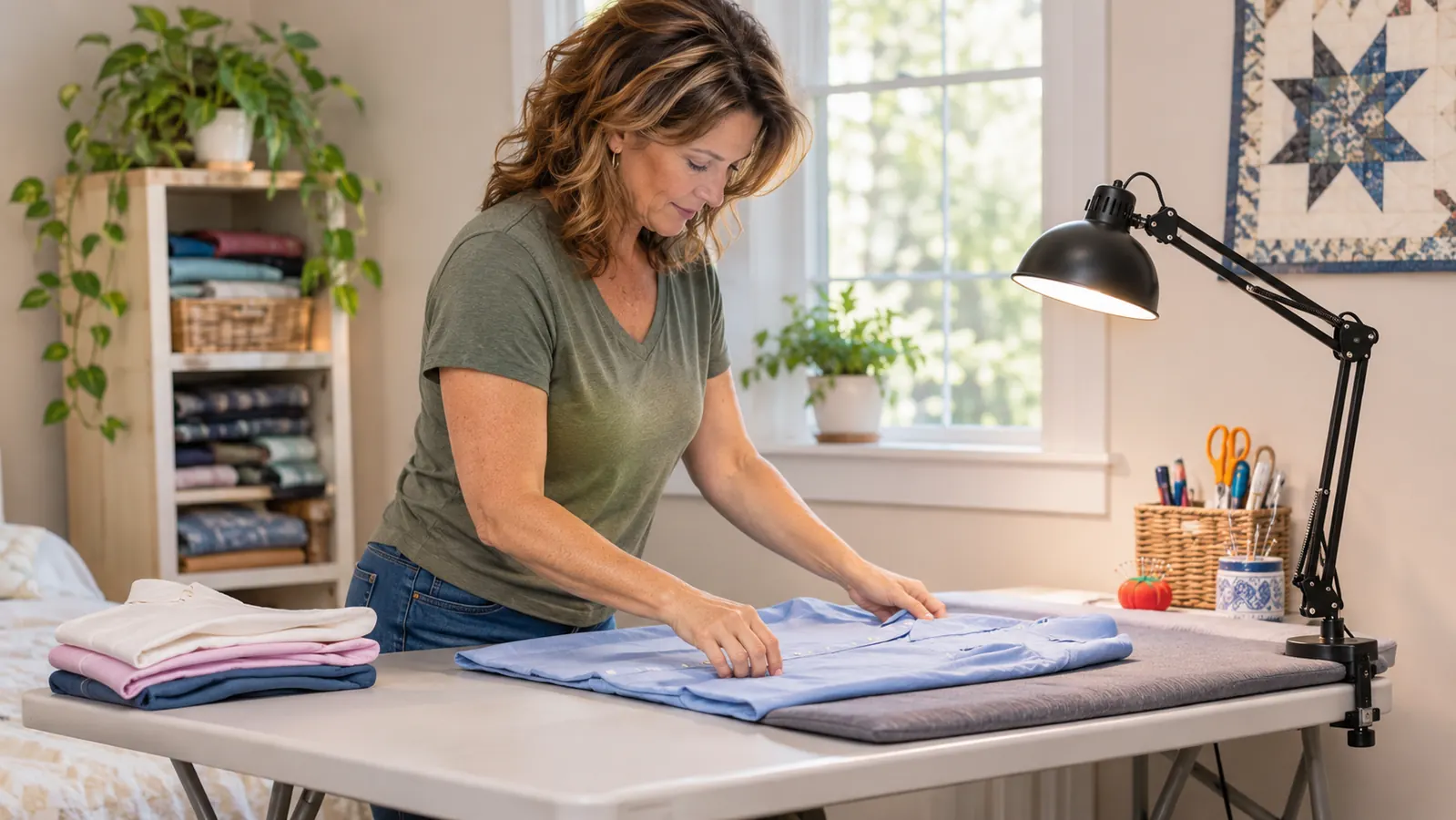
I own a household iron. It lives in the hall closet and it does a fine job on Glen's church shirts. It is a poor tool for iron-on, and I found that out in June with two test shirts. I set the iron as hot as I dared, guessed at the time, and when I pulled the carrier sheet back the lettering lifted at the corners. Both shirts went in the trash. I ordered the Cricut EasyPress SE that week and pressed all fourteen shirts for our church's summer Bible school volunteers with it. Five months later it still sits on the top shelf of the wire shelf in my spare bedroom.
I am not going to tell you a heat press is required to enjoy this hobby. I am going to tell you what changed at my table, in plain terms, so you can decide whether it earns a spot on your own shelf. These are the ten reasons I stopped reaching for the iron.
The iron guessed at the temperature. That is why the corners lifted.
The Cricut EasyPress SE holds the temperature you set, gives you a 12 inch by 10 inch pressing surface, and works with the Cricut Heat Guide for time and temperature by material.
Amazon Check Today's Price on Amazon →One 12 by 10 plate covers a whole shirt front in a single press
An iron has a small soleplate, so you shift it around in overlapping strips, and each strip cools a little before the next one lands. The pressing surface on this one is 12 inches by 10, so a standard tee front takes one placement and one press. If a design runs wider than the plate you do it in two passes, but nearly everything I have made so far fit in one.
The Cricut Heat Guide gives you the number instead of a guess
With the iron I guessed at the setting and the time. That is not a method, and it is why my first two shirts failed. The Cricut Heat Guide lists the time and temperature for the material you are pressing, and you set those numbers. I still check it every time, because a sweatshirt is not a t-shirt and a canvas tote is neither.
The temperature holds where you set it, up to 400 °F
An iron cycles. It heats, it clicks off, it heats again, and the number on the dial is a wish more than a setting. This press holds the temperature you set it to, and the top of its range is 400 °F, which is more than the guide has ever asked me for. Same heat on the first shirt of a batch as on the fourteenth.
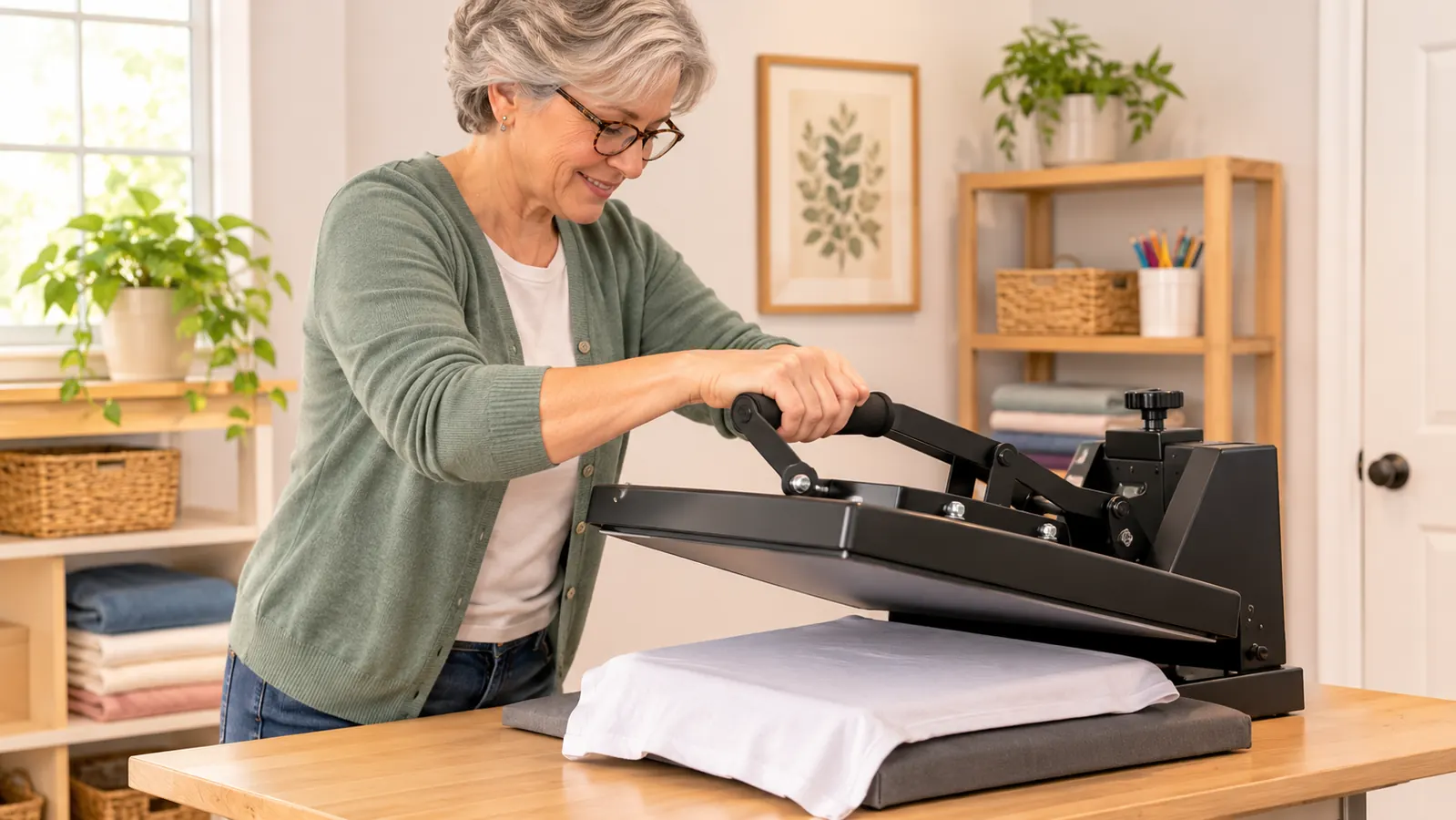
You press straight down and hold, instead of scrubbing back and forth
Iron-on wants still, even pressure for a set time. An iron encourages the opposite, because moving it is what an iron is for, and the design slides along with it. With the press you set the shirt down, set the plate down, lean on the handle, wait. Nothing travels. The carrier sheet stays exactly where you put it, which matters when the design is a row of small letters.
Fourteen shirts came out looking like the same shirt
The Bible school volunteers needed fourteen shirts with black iron-on, and that batch is what settled the argument for me. A batch is where an iron falls apart, because by shirt nine your arm is tired and your pressure is different. Fourteen through the press, one after another, and they matched. I will not tell you how many washes they survive, because I have not tested that. I will tell you they left the room looking alike.
Fourteen shirts through the press in one long afternoon, and the fourteenth looked like the first. That is the whole argument.
It goes back on its own base, so the hot face never sits on your mat
This is a small thing that matters more than it sounds. Set an iron down and it is face down on whatever is beneath it, or propped on its heel hoping it does not tip. The Cricut EasyPress SE goes back on its base between presses. You set it down, you pick it up, you stop thinking about where the hot part is. I have not scorched a shirt or a mat yet.
It presses a canvas tote or a pillow cover, not just t-shirts
Shirts are the obvious job. Since June mine has also done one canvas tote and two pillow covers for Ruth next door, same plate, same guide, different material setting. The listed uses run wider than I expected: bags, blankets, hats, pillow covers, sweatshirts, socks, mouse pads. Anything with a hard curve or a seam deep in a corner is a different problem, and I would not promise you a finished cap on the first try.
The plate is ceramic, so the heat arrives flat
The pressing surface is ceramic, which is what gives you an even face instead of a hot center and cooler edges. Evenness is the difference between a design that is bonded all over and one that is bonded in the middle and loose at the corners. Loose at the corners is exactly what I got from the iron, twice, before I stopped trying to make it work.
The whole setup stays on the folding table, no board to drag out
An iron needs a board. A board needs a closet, and getting it out needs a reason. My press comes down off the top shelf and sits on the pressing mat, and the mat never moves off its spot. That is the practical difference between a job I start at eight in the evening and a job I put off until Saturday. Convenience is not a minor feature when the hobby happens in a spare bedroom.
It takes one shelf, and it is easy to reach
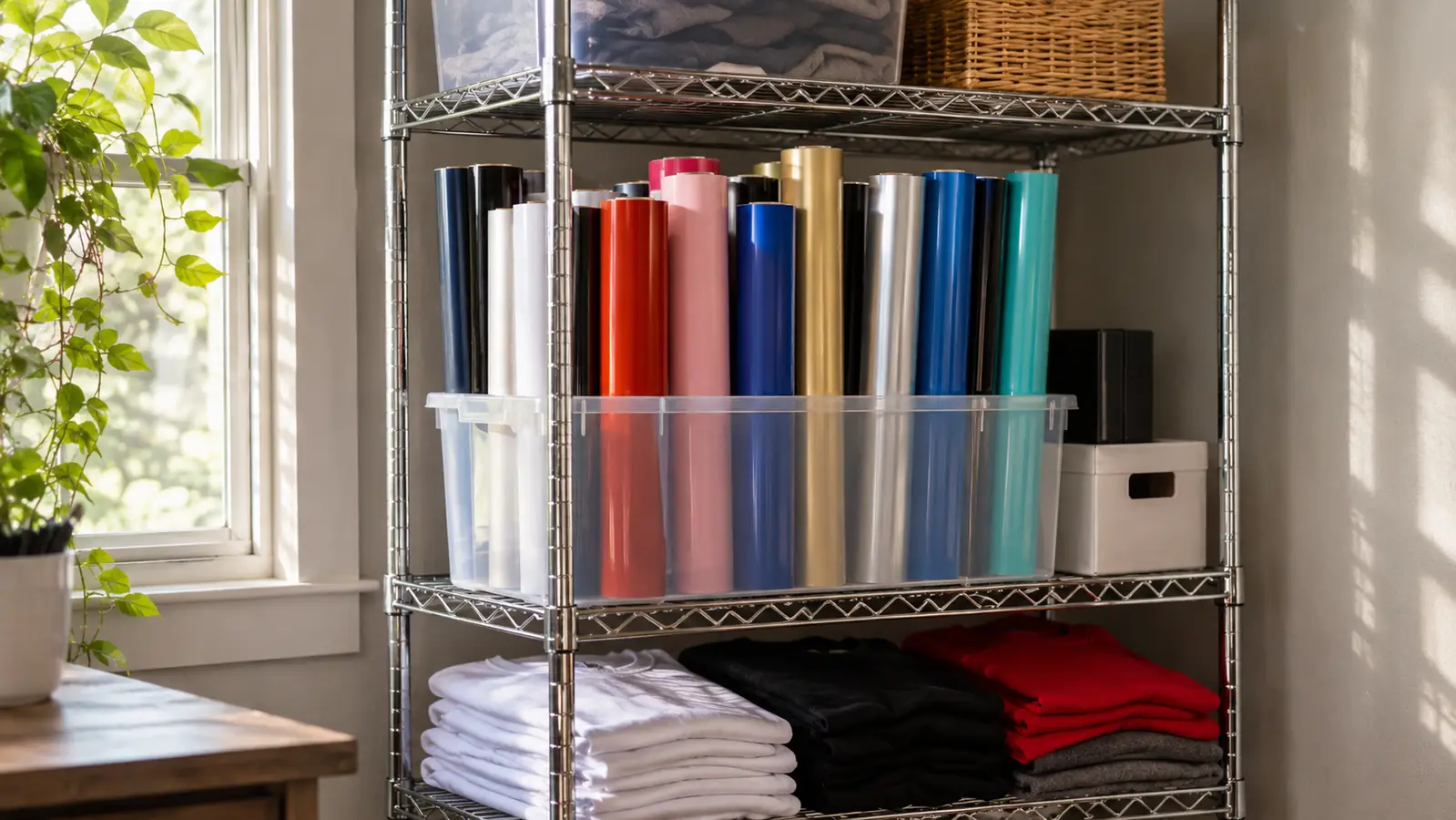
The listed size is 13.7 by 4.7 by 11.5 inches, so it is not a console taking over the room. It sits on the top shelf of my wire shelf and the vinyl rolls stand upright in a bin underneath. The tradeoff is honest: it is not instant. You wait for it to come up to temperature, and on a stack of shirts you wait once and then you work. Five months in, it still lives on that shelf.
What I'd Skip
If you are setting up a table like mine, I would skip the ironing board. The pressing mat is the surface, and a board just gives you something else to fold and store. I would skip a bag of pressing accessories too, at least at the start, because one mat has covered every shirt, tote and pillow cover I have done. And I would skip expecting the press to fix placement. It presses what you lay down. If the design is crooked going in, it comes out crisp and crooked, which is its own kind of heartbreak. The honest limit is size: this is a handheld plate, so on anything larger than a shirt front you work in sections and think about where the seams fall before you start, not after.
If an iron has already lifted the corners on you once, this is the fix.
One 12 by 10 pressing surface, a temperature you set and it holds, and the Cricut Heat Guide for every material you try. Five months on my shelf and it has not gone back in the closet.
Amazon Check Today's Price on Amazon →