
The Cricut EasyPress SE is the one thing in my spare bedroom I was sure I did not need. I bought a vinyl cutter in March. For three months I told myself a household iron would handle the handful of shirts I wanted to make, and I believed it right up until I pressed two test shirts, pulled the carrier sheet back, and watched the lettering lift at the corners. I ordered this press that week.
That was June. Since then it has pressed fourteen shirts for the summer Bible school volunteers at our church, one canvas tote, two pillow covers for my neighbor Ruth, and a few shirts for the one craft fair I did in October. Five months. That is the entire history of the thing, and it is enough to tell you what living with it is actually like, including the parts the product page leaves out.
This is not a list of what Cricut prints on the box. It is the review I wish someone had handed me in June, from a woman in Tulsa with a folding table and a small cutter.
The Quick Verdict
A hot flat plate and a set of instructions that are actually right. It replaced my iron and I would order it again, as long as you understand that you are the part that presses.
Amazon Check Today's Price →Five months in, I would still order it in June
The pressing surface is 12 inches by 10. The plate is ceramic and Cricut rates it to 400 degrees Fahrenheit. Current price and the full spec sheet are on the listing.
Amazon Check today's price on Amazon →The Part Nobody Puts in the Unboxing Video: You Are the Press
There is no lever, no arm, no clamp that comes down. The EasyPress SE is a flat ceramic plate with a handle, 13.7 inches long, 11.5 inches tall and 4.7 inches wide, with a pressing surface of 12 inches by 10. Cricut rates the upper temperature at 400 degrees Fahrenheit and covers it with a one year limited warranty. What is not in any of that is a mechanism that applies pressure for you. You press down with your own arm, and you hold it there.
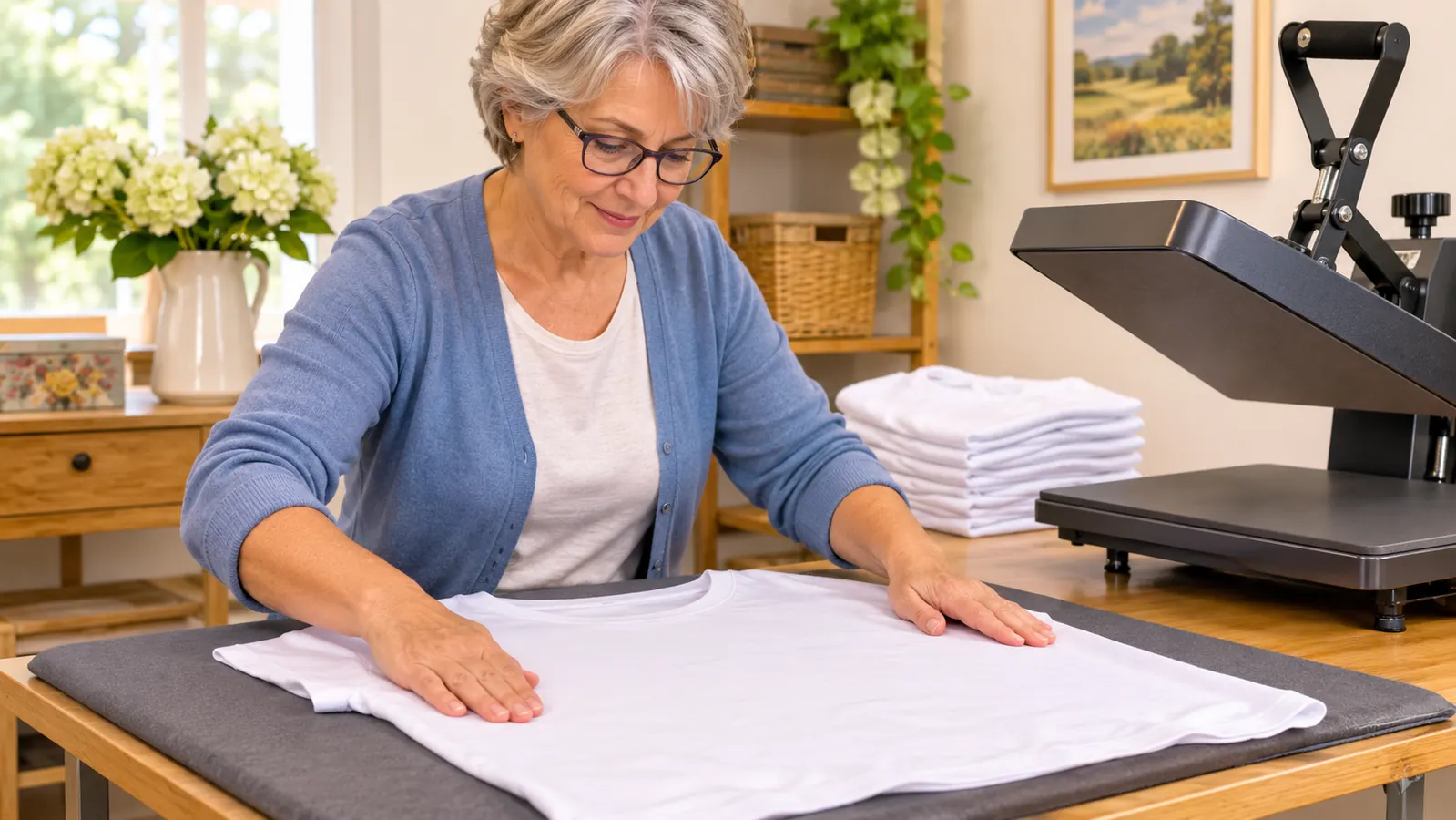
On a shirt front that is genuinely fine. The plate covers most of an adult front in one placement, so I set it down, lean on the handle and wait through the count. Where it changes is anything bigger. You work in sections, moving the plate, overlapping the last inch so you do not leave a pale stripe, and keeping track of where you have already been. I have not pressed anything larger than a shirt front and I do not want to.
If you have only ever seen a clamshell press with a lever and assumed this was the same sort of tool, it is not. That is not a flaw exactly. It is a difference, and it decides the whole question of whether this suits you. Fourteen shirts in one long afternoon was a fine day's work. Forty would have been a long, tired day, and my shoulder would have had opinions.
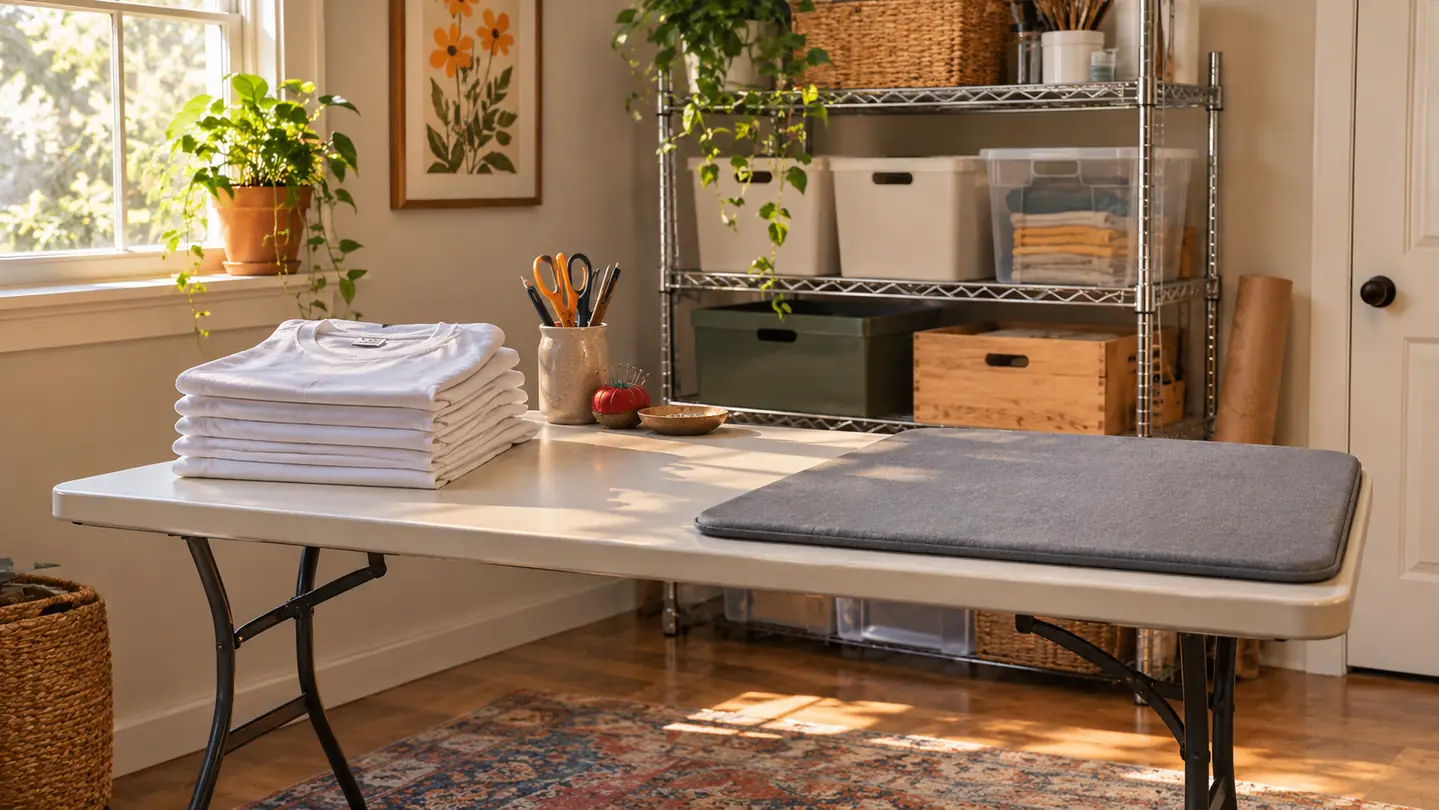
The other half of the pressure question is what is underneath. You need a firm, flat, heat safe pad and a table that does not rock. My table is a six foot folding table that was in that room before any of this was, and it has been steady enough. A wobbly card table would not be, and I would not try this on a counter with a dish towel under it.
What Five Months of Real Use Actually Looks Like
The job that made me buy the press was the fourteen shirts in June. Black iron-on for the volunteers, all pressed in one long afternoon. Every one of them has stayed down. Nobody has brought a shirt back to me, and I have asked.
After that it went quiet for a while, which is the honest shape of this hobby for me. A few projects a month. A canvas tote. The two pillow covers for Ruth, who wanted something plain for her den. A few more shirts after that. Some weeks the press does not come off the shelf at all.
It lives on the top shelf of the wire shelf in the spare bedroom, with the vinyl rolls standing upright in a plastic bin on the middle shelf. The cutter stays on the table. When I need the press I bring it down, set it on the mat at the right end of the table and let it come up to heat. When I am done I set it back on its base and put it away. That routine has not gotten old in five months, which is more than I can say for some things in that room.
The frequency matters for how you read this review. I spent my working life in a school office and now I make things for my church and my neighbors. I am not running a shop. A press that sits untouched for two weeks and then works perfectly is exactly what I needed. If you need one that runs all day, five days a week, my experience will not tell you much, and I would rather say so than guess.
The Heat Guide Is Why a Beginner Could Do This
Before June I had never touched iron-on. I want to be clear about that, because it explains the one thing I would tell anyone starting out: the settings are the hard part, and Cricut takes that part off your hands.
The Heat Guide is a lookup. You tell it what material you are pressing and what it is going onto, and it gives you the temperature, the time and the order of steps. I use it every single time. I have not memorized it and I do not intend to. My memory is fine for a grocery list and not for timings.
With the household iron I was guessing. I had no guide for an iron and no way to know whether the setting was right, and guessing is what produced those first two shirts with the corners lifting. That is the whole difference between the two approaches, and it has nothing to do with the name on the handle.
The guide does not make you fast. You still wait for the plate to come up, and you still hold through the count. But you are not improvising, and improvising is where a nervous beginner loses a shirt. I have not scorched anything and I have not burned myself, and I put a good deal of that down to doing what the guide said instead of what I felt like.
You are not buying a machine that presses for you. You are buying a hot flat plate and a set of instructions that are actually right.
The Annoyances, In the Order They Bother Me
It has to heat up, and there is nothing to do about that but wait. I lay out the next shirt and check the carrier sheet while it comes up, so the time is not wasted, but a person who wants to walk in and start pressing will notice the wait every single time. It is the sort of small friction that does not matter once and grates by the tenth shirt.
The plate is generous for a shirt front and no help at all beyond it. Cricut lists a long set of recommended uses, blankets and bags and hats and pillow covers among them, and from that list I have only done the pillow covers and the tote. A hat I would not attempt with a plate this size. A blanket I would want to do in sections, on the floor, with someone helping, and I have not tried it.
It takes up shelf space. This is a small complaint from someone with a spare bedroom and it would be a real one from someone in a small apartment. It is 13.7 inches long and 11.5 inches tall, so it wants a shelf with room and a wall behind it, and it wants to be somewhere it will not get knocked.
You also end up buying a pressing mat if you do not have one, and a mat is not optional. The plate is hot and it needs somewhere to sit between presses that is not the shirt and not the bare table. I keep mine at the right end of the folding table, permanently, and the press sits on its base beside it when it is working.
And then there is the thing I keep coming back to. You are the pressure. On a long run your arm knows it. I would not call that a defect, because it is the trade you make for something this small and this easy to put away, but nobody should be surprised by it on the second shirt.
What I Compared It To, and What I Did Not
I have not used the HTVRONT heat press. It comes up whenever anyone asks about another option, and I am not going to pretend I can compare them from experience. What I can say is that the question is the same for any press: does it apply the pressure for you, or do you apply it yourself, and how big a piece can you cover in one placement.
I have used my friend Bev's Silhouette Portrait 4 twice, at her house, and that is a cutter rather than a press, so it does not answer this question at all. Bev sat with me both times. Her machine is fine. It is simply a different job.
What I would tell you to weigh is whether you already own a Cricut cutter. If you do, this press slots in without any new thinking. The guide already knows the materials you use and the mat is already on your table. If you do not, you are buying a hot plate with a handle, and there are other hot plates with handles. That is not a knock on this one. It is just an honest way to decide.
The Order of Operations on a Pressing Day
A pressing day starts the evening before, at the cutter. I cut the iron-on, weed it and leave the carrier sheet intact. In the morning the press comes down off the shelf and goes on the right end of the table on the mat. The laptop stays in the middle. The shirts get stacked to one side in the order I want to press them, because once the plate is hot I do not want to be hunting for anything.
You press the shirt first to get the moisture out, then place the design, then press the design, then peel. The peel is the moment of truth, and warm peel or cool peel depends on the material, which the guide tells you. Getting that wrong is how a person ends up with a design that looks fine on the table and lifts a week later.
Here is the part I did not expect. The press makes the whole day shorter, and not because it presses faster than an iron. It is because you stop second guessing. With the iron I would press, peel, look at it, press again and worry. With the press I look up the setting, do it and move on. That is worth something when there are fourteen shirts stacked beside you and the afternoon is getting on.
Three Details I Did Not Expect to Care About
The plate is ceramic, and if the heat varies across it I never caught it. What I noticed on the fourteen shirts was that no corner took differently from the middle, pressing one after another with no pauses. With an iron I could never have told you whether that was true.
The number that matters is the pressing surface, not the size of the machine. Twelve inches by ten covers a shirt front. An iron covers a patch about the size of a dinner plate and makes you move it six times, which is how designs end up with a seam pressed through them.
Setting it back on its base instead of laying it face down on the mat. Small habit, but it keeps the mat flat and keeps the plate off things it should not be resting on.
The warranty is one year limited, which is not a long time. Five months in, nothing has given me a reason to think I will need it.
What I Liked
- Covers a shirt front in one placement, so most projects are a single press instead of six
- The Cricut Heat Guide hands you the temperature and the time, which is the part beginners get wrong
- Small enough to live on the top shelf and come down when you need it
- Ceramic plate rated to 400 degrees Fahrenheit, with a one year limited warranty
- Almost no learning curve beyond looking up your material and holding the handle down
Where It Falls Short
- You are the press. There is no lever, so a long run of shirts is a long run of leaning
- You wait for it to heat up every single time
- The 12 by 10 plate is no help on anything bigger than a shirt front
- It is a single purpose object that wants shelf space and a wall behind it
- Wrong tool for anyone pressing in volume, and I am not going to pretend otherwise
Who This Is For
You own a Cricut cutter. You make shirts, totes and pillow covers in small batches, for family, for friends, for a church. You have tried an iron and did not trust the result. This press solves that specific problem, and it does it without asking you to learn anything beyond looking up your material.
It also suits someone who presses occasionally. A few times a month is my pace. The press does not mind sitting for two weeks. It comes off the shelf, it heats, you press, you put it away, and the shelf takes it back.
Who Should Skip It
Skip it if you press in volume. A press with a lever does the work of pressing for you, and if you are making dozens of shirts a week your arm will explain the difference by Thursday afternoon. I did fourteen in one long afternoon and I was glad to sit down afterward.
Skip it if you make large things. Blankets, long banners, the whole back of a jacket. The plate is 12 inches by 10, and on anything larger you are working in sections and hoping your overlaps come out even.
And skip it if you do not own a Cricut cutter and do not plan to. The press is good on its own merits, but a good part of what makes it easy is the way it fits with the rest of the system. Without the cutter, the guide and the mat, you are buying a hot flat plate, and I would want you to know that before you decide.
The press that ended my argument with the iron
Five months of shirts, one tote and two pillow covers. If that sounds like your kind of workload, this is the one I would buy again.
Amazon Check today's price on Amazon →