
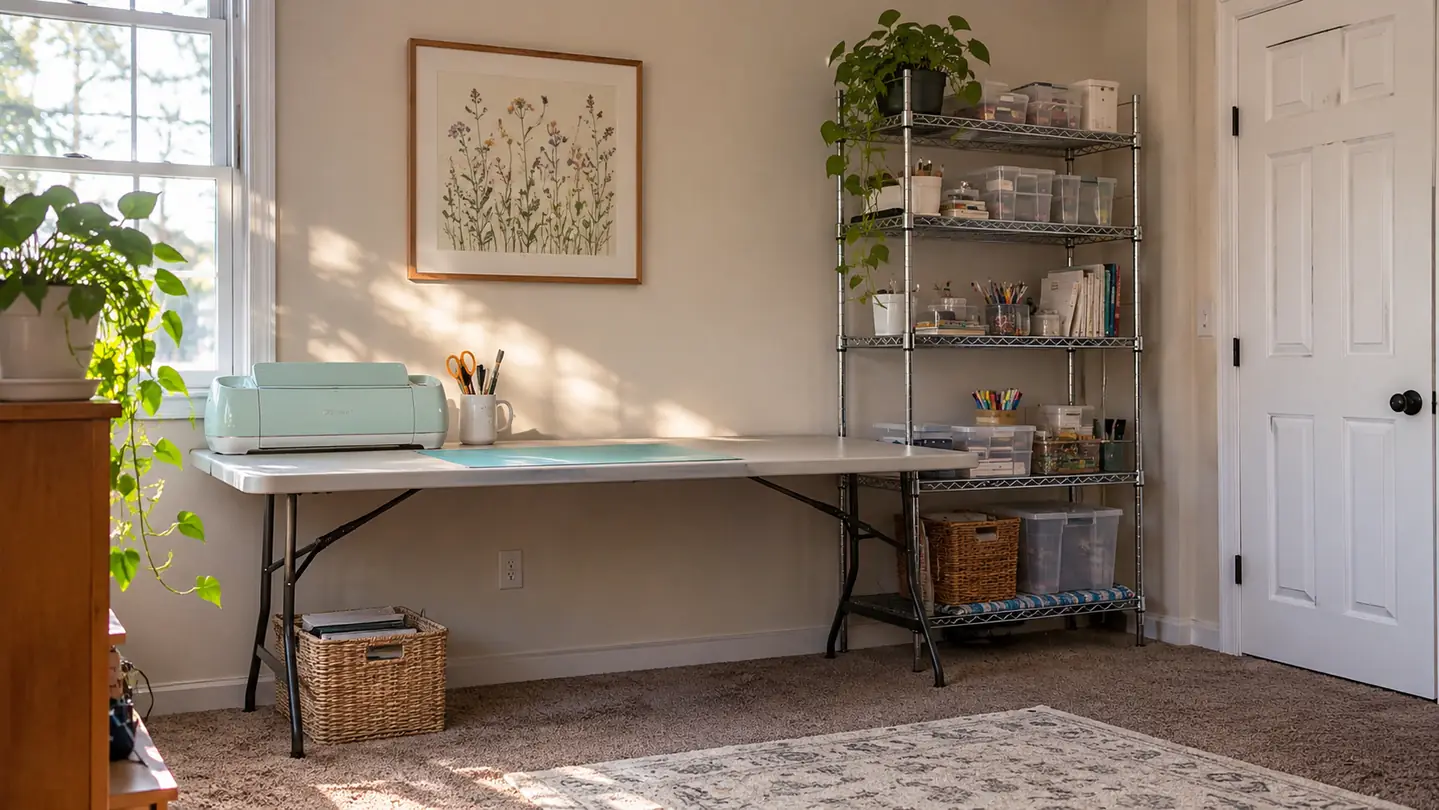
I had never cut vinyl in my life before March. I am 58, I spent my working years in the front office of a school here in Tulsa, and I had a spare bedroom with a folding table in it and no good reason to walk in there. Then my friend Bev showed me a small name decal on her water bottle at church, and I spent a month telling myself I did not need a machine.
I bought the Cricut Joy Xtra. It has been on the left end of that table for eight months now, with my weeding tools standing in a mug beside it, and the reason I am writing this is that people keep asking me which big machine to buy. My answer is that a big machine is the wrong question in a room like mine. Here are ten reasons the small one fits.
See the machine that fits on half a folding table
The Cricut Joy Xtra is the one at the left end of my table. Current price and the full listing are on Amazon.
Amazon Check today's price on Amazon →It takes up 12.5 inches of table and nobody needs that back
The machine measures 12.5 inches wide, 6 inches deep and 5.5 inches high, and weighs 6 pounds. On a six foot folding table that is a corner, not a commitment. I still have the middle for my laptop and the right end for a pressing mat, and I never had to buy a second piece of furniture or move anything out of the room. If you have ever measured a spare bedroom and come up short, that number is the whole argument.
The spare bedroom never had to become anything else
This is the part I did not expect. The room is still a spare bedroom. There is a bed in it. I slide the chair out, sit down, cut, and stand up again. Glen pokes his head in maybe once a week to see what is on the table. Nothing about the room announces itself as a workshop, and I like that more than I thought I would. A machine that demands its own room is a machine that ends up in a closet.
You can carry it with one hand and set it down anywhere
Six pounds. At 6 pounds it was no strain to lift out of the box, and I never once thought about where my back was. If your craft space is a corner of a den and the machine has to go back on a shelf some weeks, this is a machine that lets you do that without a production. It also means I can turn it around to reach the back of it without walking around the table.
It cuts on an 8.5 inch mat, so your vinyl scrap pile stays small
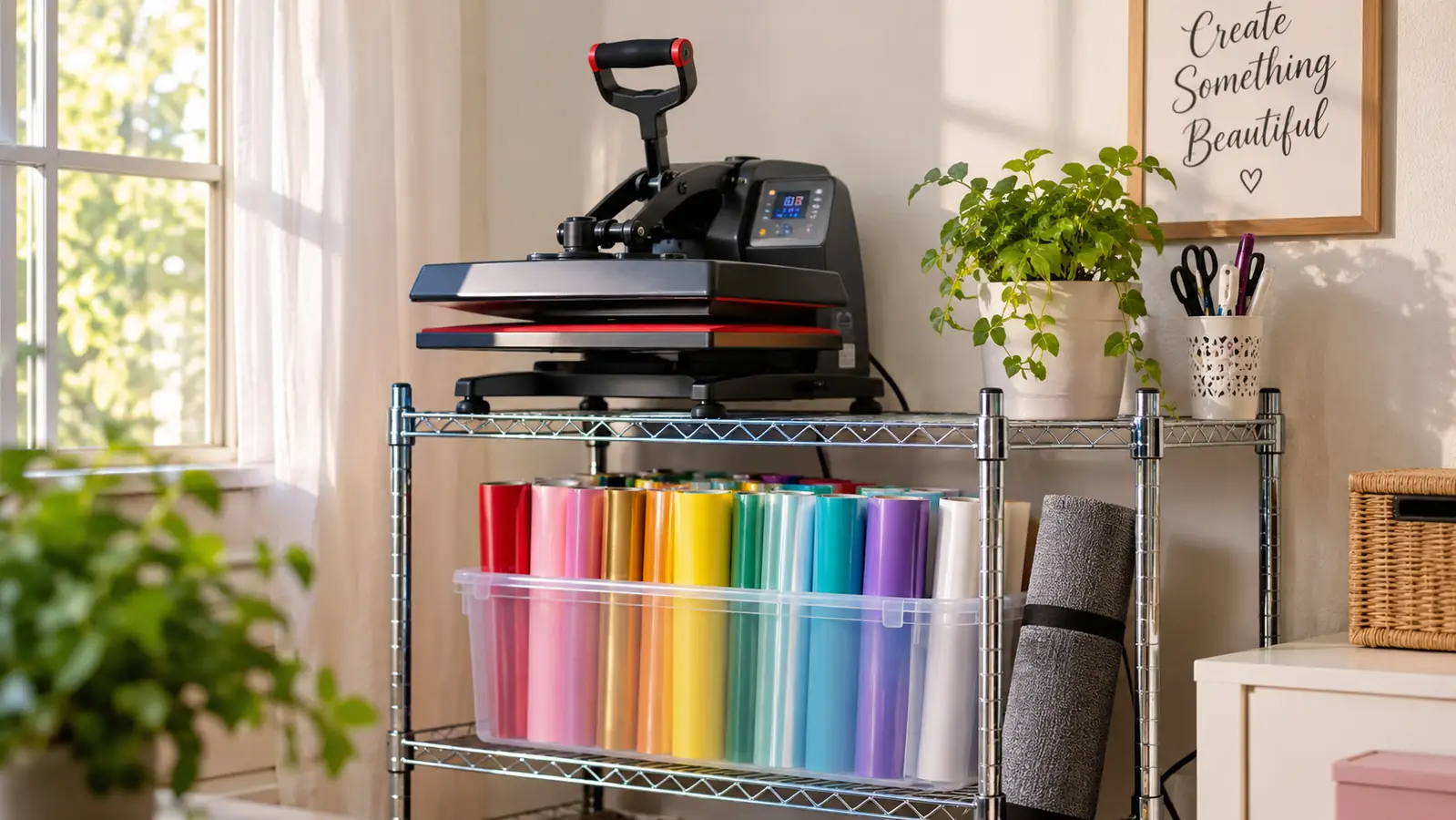
The Cricut mat for this machine is 8.5 inches wide. I buy a 12 inch roll of vinyl and trim it with scissors at the table before it ever goes near the machine. That sounds like a nuisance and it is mildly one, but it also means I am never cutting a two foot sheet for a four inch decal. My scraps fit in a shoebox, and the roll itself stands upright in a plastic bin on the wire shelf instead of leaning against a wall.
Fifty materials means you are not buying a machine for one hobby
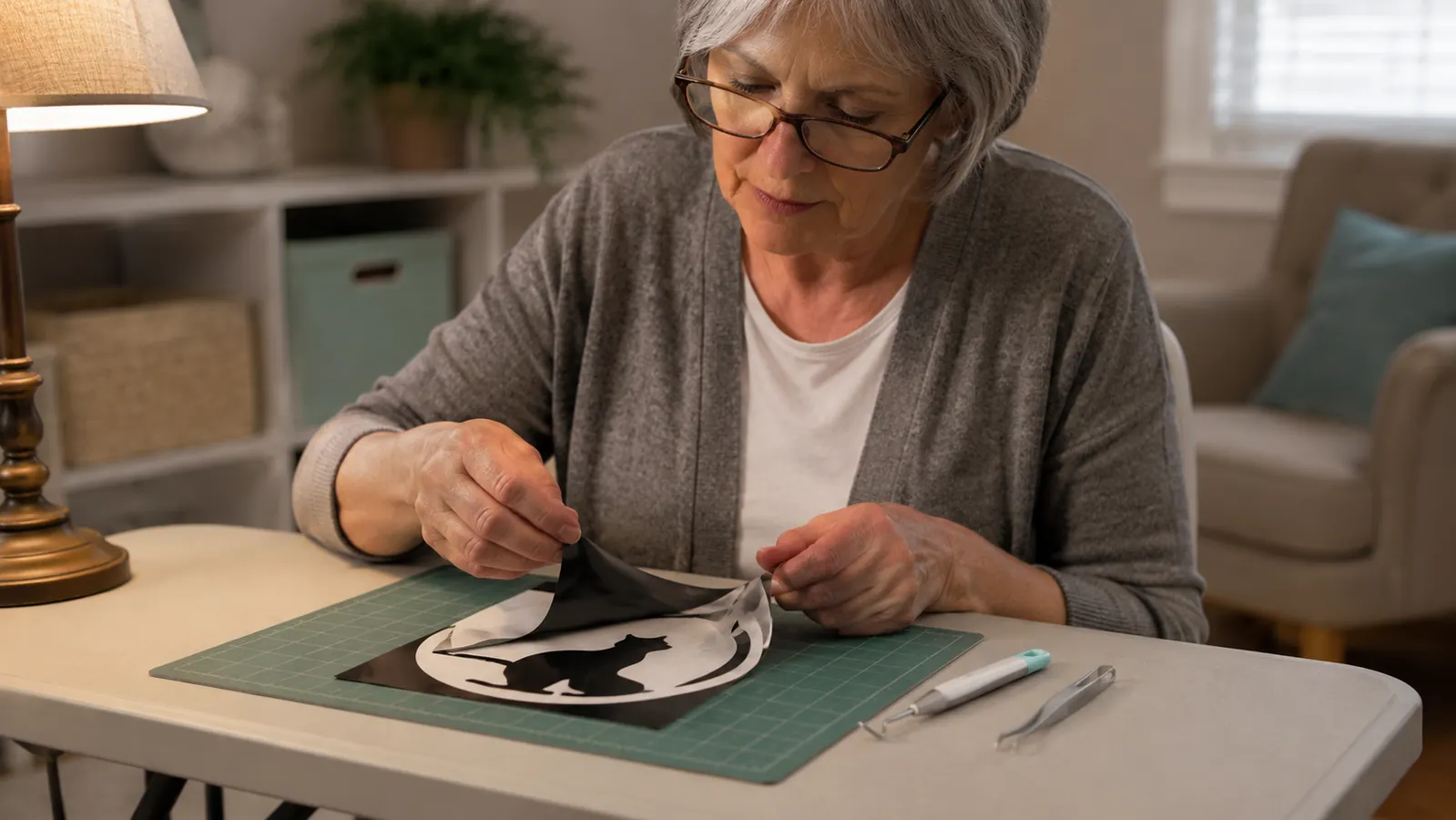
The listing says it works with more than 50 materials, vinyl and iron-on and cardstock among them. In eight months I have cut exactly three: permanent vinyl, iron-on, and cardstock once for a card. The point is not that I use fifty. The point is that when Ruth asked for house numbers and my church asked for shirts, I did not need a different machine for either, and I did not need to learn a second piece of software.
There is a free image library, so the room stays uncluttered
Cricut includes 3,000 images and 100 fonts in the free content, and the wider Design Space library runs past 1.5 million. I am not a designer. I type a name, pick a font I can read from across a room, and cut it. No bins of paper patterns, no drawers of stencils, no shelf of books. The designs live on the laptop and the laptop lives on the table, and the shelf holds a bin of vinyl and tape, plus the heat press I added in June.
Design Space is confusing for one week and then it is not
I want to be honest with you, because I was nervous about the software and I do not think anyone should pretend otherwise. My first week with Cricut Design Space was rough. By May I was comfortable, and I started in March. That is roughly ten weeks, and most of it was me being scared of a menu. The machine handles the cut once you pick the material, and I have never adjusted the blade or changed it.
It is quiet enough to run in a bedroom while Glen watches television
This matters more in a small house than it sounds. The machine is not silent, but it is not a thing you have to warn anyone about. I cut in the evening with the door open and Glen has never once turned the volume up. A tool you feel you have to apologize for is a tool you stop using, and that is true of a machine, a sewing machine, or anything else that makes noise in a house with thin walls.
Small jobs are the actual jobs, and this is a small-job machine
A name decal on Glen's toolbox. House numbers on Ruth's mailbox. Labels for classroom doors. Words on a church office door. That is the work. It is not banners and it is not big signs, and honestly I turned down a request for a large church banner because I knew the machine would not do it. A narrow machine tells you the truth about what you are going to make.
It leaves room in the budget for the things you actually need
A cutter by itself does not get you finished decals. You need vinyl, you need weeding tools, and you need transfer tape. I bought all of that at once and I have only ever replaced the vinyl. When the machine is not the whole cost of the hobby, you can afford the bits that make the hobby work, and that is the difference between a machine that sits and a machine that gets used on a Tuesday evening.
What I'd Skip
If you have a spare bedroom and a folding table, skip the bigger machine. I know that sounds like I am talking myself into my own purchase, but the arithmetic is plain. A wide machine wants width you do not have and does work you are not doing. I am not cutting signs for a storefront. I am cutting a name for a toolbox and a set of numbers for a neighbor's mailbox. The narrow machine is not a compromise in that room. It is the correct size, and the only real cost is that wide vinyl has to be trimmed with scissors before it goes in, which takes me about a minute at the table.
I turned down a request for a large church banner because I knew the machine would not do it. Knowing what your tool will not do is most of the skill.
The other thing I would skip is buying the machine and nothing else. A cutter with no vinyl and no weeding hook is a box on a shelf. Buy the roll, buy the tools in the little set, buy the transfer tape, and then sit down and cut something small and not very important on the first evening. Mine was a name for Glen's toolbox. The G tore because I was weeding with a straight pin from my sewing box. The second one worked, and it is still on that toolbox eight months later.
And if you are the sort of person who is waiting to feel ready, I would skip that too. I was not ready in March. I was retired, with a laptop and a folding table and a friend who owned a Silhouette Portrait 4 and let me try it twice at her house. The Cricut Joy Xtra went on the table and stayed there. That is the whole story, and it is the reason I answer this question the same way every time someone asks me which machine to buy.
Start with the machine that fits the room you actually have
Eight months on the left end of a folding table in a spare bedroom. Current price and details are on the Amazon listing.
Amazon Check today's price on Amazon →